
 For a better mobile experience, please rotate the screen.

What is portfolio diversification?
Disclaimer announcement to users that full disclaimers will be shown once they hover over
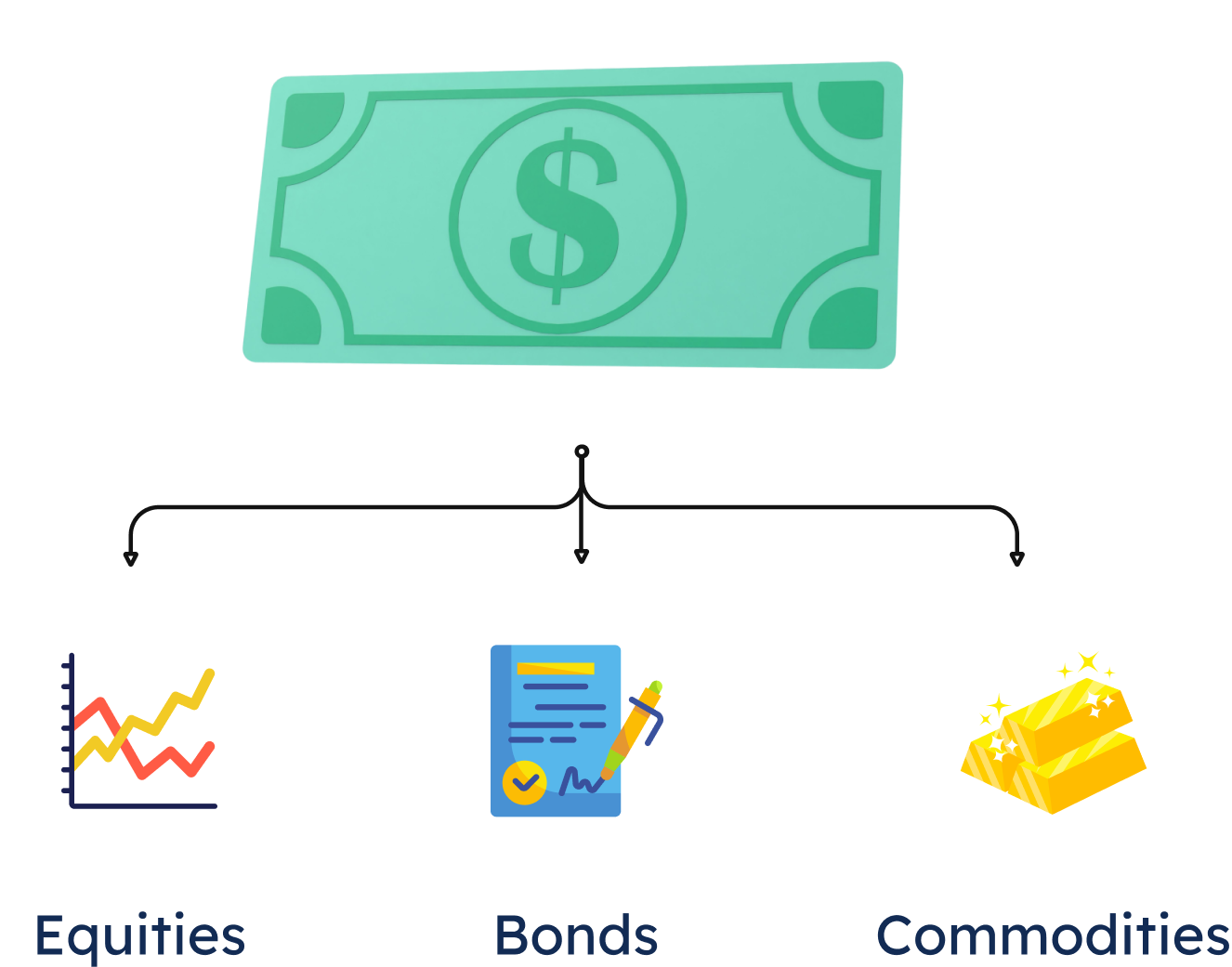
In the universe of investment, we often hear the phrase Do not put all your eggs into one basket. Putting into context, it means avoiding investing all your money in a single asset class.

By investing all your money in a single asset class, you may potentially lose all your money if the investment value of that asset class falls to zero.

Diversification
In contrast, having a portfolio that invests in different asset classes, the risk of losing all your money may be potentially mitigated.
Diversification
Investing into different asset classes is a concept called diversification.

Diversification
reduces
risk
In times of crisis, diversification may potentially helps to lower the impact of market volatility.

How does diversification reduce risk?
The key is correlation.

Correlation
Often, stocks and bonds have what is called a negative correlation.
For example, when the stock market is doing well, and stock prices are going up, investors are generally feeling confident and are more likely to invest in stocks.
During these times, they might sell off bonds, which are considered to have lower risk as compared to stocks but offer lower returns. This selling can lead to lower bond prices.

Conversely, when the stock market is doing poorly, investors often seek the safety of bonds, pushing their prices up. In essence, when stocks prices are up, bonds prices might be down, and vice versa.

Stability in Portfolio
Essentially, adding bonds to a portfolio may potentially reduce volatility and stabilise the portfolio's performance, especially in turbulent market conditions.

Basic Rule
Mitigate the risk of volatility in a portfolio by including different asset classes with returns that are less correlated with each other.

High Risk, High Return
Equity market potentially offers a higher return, but it also comes with a higher risk.
Including another asset class, for example bonds, may potentially reduce a portfolio’s overall risk.


Great that you understand more about diversification! Adding global bonds to a domestic equities portfolio can potentially provide valuable diversification benefits, especially during market crisis. Let's go through some examples.
Source: Bloomberg, Global Financia Crisis data is from 08 Oct 2007 to 09 Mar 2009, Equity refers to
Stock Exchange of Thailand SET Index. Bond refers to Bloomberg Global-Aggregate Total Return Index Value
Unhedged USD. Thailand equity performance is calculated in THB while the bond performance is calculated
in USD; on a last price-to-last price basis. SGD based investors are exposed to non-SGD foreign exchange
fluctuations. The information above is provided only for illustrative purposes to demonstrate
diversification concept, it should not be considered a recommendation to purchase or sell any particular
index or strategy or an investment advice. Past performance, or any prediction, projection or forecast,
is not indicative of future performance.
Back to map
Thailand
Volatility (%)
15
13
11
9
7
5
3
100:0
Portfolio volatility for 100% equity to 0% bond ratio is 14.7%.
90:10
Portfolio volatility for 90% equity to 10% bond ratio is 13.3%.
80:20
Portfolio volatility for 80% equity to 20% bond ratio is 11.9%.
70:30
Portfolio volatility for 70% equity to 30% bond ratio is 10.4%.
60:40
Portfolio volatility for 60% equity to 40% bond ratio is 9.0%.
50:50
Portfolio volatility for 50% equity to 50% bond ratio is 7.7%.
40:60
Portfolio volatility for 40% equity to 60% bond ratio is 6.4%.
30:70
Portfolio volatility for 30% equity to 70% bond ratio is 5.2%.
20:80
Portfolio volatility for 20% equity to 80% bond ratio is 4.2%.
10:90
Portfolio volatility for 10% equity to 90% bond ratio is 3.6%.
12
10
8
6
4
2
100:0
Portfolio volatility for 100% equity to 0% bond ratio is 11.9%.
90:10
Portfolio volatility for 90% equity to 10% bond ratio is 10.7%.
80:20
Portfolio volatility for 80% equity to 20% bond ratio is 9.5%.
70:30
Portfolio volatility for 70% equity to 30% bond ratio is 8.3%.
60:40
Portfolio volatility for 60% equity to 40% bond ratio is 7.1%.
50:50
Portfolio volatility for 50% equity to 50% bond ratio is 6.0%.
40:60
Portfolio volatility for 40% equity to 60% bond ratio is 4.9%.
30:70
Portfolio volatility for 30% equity to 70% bond ratio is 3.8%.
20:80
Portfolio volatility for 20% equity to 80% bond ratio is 3.0%.
10:90
Portfolio volatility for 10% equity to 90% bond ratio is 2.6%.
33
29
25
19
15
10
6
100:0
Portfolio volatility for 100% equity to 0% bond ratio is 32.6%.
90:10
Portfolio volatility for 90% equity to 10% bond ratio is 29.4%.
80:20
Portfolio volatility for 80% equity to 20% bond ratio is 26.1%.
70:30
Portfolio volatility for 70% equity to 30% bond ratio is 22.9%.
60:40
Portfolio volatility for 60% equity to 40% bond ratio is 19.8%.
50:50
Portfolio volatility for 50% equity to 50% bond ratio is 16.7%.
40:60
Portfolio volatility for 40% equity to 60% bond ratio is 13.7%.
30:70
Portfolio volatility for 30% equity to 70% bond ratio is 10.9%.
20:80
Portfolio volatility for 20% equity to 80% bond ratio is 8.5%.
10:90
Portfolio volatility for 10% equity to 90% bond ratio is 6.9%.
-0.8
-2
-4
-5
-8
-10
-12
100:0
Portfolio drawdown for 100% equity to 0% bond ratio is -11.3%.
90:10
Portfolio drawdown for 90% equity to 10% bond ratio is -10.2%.
80:20
Portfolio drawdown for 80% equity to 20% bond ratio is -9.0%.
70:30
Portfolio drawdown for 70% equity to 30% bond ratio is -7.8%.
60:40
Portfolio drawdown for 60% equity to 40% bond ratio is -6.6%.
50:50
Portfolio drawdown for 50% equity to 50% bond ratio is -5.5%.
40:60
Portfolio drawdown for 40% equity to 60% bond ratio is -4.3%.
30:70
Portfolio drawdown for 30% equity to 70% bond ratio is -3.1%.
20:80
Portfolio drawdown for 20% equity to 80% bond ratio is -1.9%.
10:90
Portfolio drawdown for 10% equity to 90% bond ratio is -0.8%.
1.2
0.7
0.3
-0.1
-0.6
-1.0
-1.5
100:0
Portfolio drawdown for 100% equity to 0% bond ratio is -1.5%.
90:10
Portfolio drawdown for 90% equity to 10% bond ratio is -1.2%.
80:20
Portfolio drawdown for 80% equity to 20% bond ratio is -0.9%.
70:30
Portfolio drawdown for 70% equity to 30% bond ratio is -0.6%.
60:40
Portfolio drawdown for 60% equity to 40% bond ratio is -0.3%.
50:50
Portfolio drawdown for 50% equity to 50% bond ratio is 0.0%.
40:60
Portfolio drawdown for 40% equity to 60% bond ratio is 0.3%.
30:70
Portfolio drawdown for 30% equity to 70% bond ratio is 0,6%.
20:80
Portfolio drawdown for 20% equity to 80% bond ratio is 0,9%.
10:90
Portfolio drawdown for 10% equity to 90% bond ratio is 1,2%.
-6.2
-11.8
-17.4
-23.0
-28.6
-34.2
-39.8
-45.4
-51.0
-56.6
-62.3
100:0
Portfolio drawdown for 100% equity to 0% bond ratio is -62.3%.
90:10
Portfolio drawdown for 90% equity to 10% bond ratio is -56.1%.
80:20
Portfolio drawdown for 80% equity to 20% bond ratio is -49.9%.
70:30
Portfolio drawdown for 70% equity to 30% bond ratio is -43.6%.
60:40
Portfolio drawdown for 60% equity to 40% bond ratio is -37.4%.
50:50
Portfolio drawdown for 50% equity to 50% bond ratio is -31.2%.
40:60
Portfolio drawdown for 40% equity to 60% bond ratio is -24.9%.
30:70
Portfolio drawdown for 30% equity to 70% bond ratio is -18.7%.
20:80
Portfolio drawdown for 20% equity to 80% bond ratio is -12.5%.
10:90
Portfolio drawdown for 10% equity to 90% bond ratio is -6.2%.
Equity: Bond Ratio
Read the full discloser here
Source: Bloomberg, Global Financial Crisis data is from 08 Oct 2007 to 09 Mar 2009, Equity refers to
FTSE Bursa Malaysia KLCI Index - Kuala Lumpur Composite Index. Bond refers to Bloomberg Global-Aggregate
Total Return Index Value Unhedged USD. Malaysia equity performance is calculated in MYR while the bond
performance is calculated in USD; on a last price-to-last price basis. SGD based investors are exposed
to non-SGD foreign exchange fluctuations. The information above is provided only for illustrative
purposes to demonstrate diversification concept, it should not be considered a recommendation to
purchase or sell any particular index or strategy or an investment advice. Past performance, or any
prediction, projection or forecast, is not indicative of future performance.
Back to map
Malaysia
Drawdown (%)
9.3
8.3
7.3
6.3
5.3
4.3
3.4
100:0
Portfolio volatility for 100% equity to 0% bond ratio is 9.3%.
90:10
Portfolio volatility for 90% equity to 10% bond ratio is 8.4%.
80:20
Portfolio volatility for 80% equity to 20% bond ratio is 7.5%.
70:30
Portfolio volatility for 70% equity to 30% bond ratio is 6.7%.
60:40
Portfolio volatility for 60% equity to 40% bond ratio is 5.8%.
50:50
Portfolio volatility for 50% equity to 50% bond ratio is 5.0%.
40:60
Portfolio volatility for 40% equity to 60% bond ratio is 4.4%.
30:70
Portfolio volatility for 30% equity to 70% bond ratio is 3.8%.
20:80
Portfolio volatility for 20% equity to 80% bond ratio is 3.5%.
10:90
Portfolio volatility for 10% equity to 90% bond ratio is 3.4%.
10.6
8.9
7.3
5.6
4.0
2.4
100:0
Portfolio volatility for 100% equity to 0% bond ratio is 10.6%.
90:10
Portfolio volatility for 90% equity to 10% bond ratio is 7.9%.
80:20
Portfolio volatility for 80% equity to 20% bond ratio is 7.0%.
70:30
Portfolio volatility for 70% equity to 30% bond ratio is 6.1%.
60:40
Portfolio volatility for 60% equity to 40% bond ratio is 5.2%.
50:50
Portfolio volatility for 50% equity to 50% bond ratio is 4.4%.
40:60
Portfolio volatility for 40% equity to 60% bond ratio is 3.6%.
30:70
Portfolio volatility for 30% equity to 70% bond ratio is 3.0%.
20:80
Portfolio volatility for 20% equity to 80% bond ratio is 2.6%.
10:90
Portfolio volatility for 10% equity to 90% bond ratio is 2.4%.
18.7
16.7
14.7
12.7
10.7
8.7
6.7
100:0
Portfolio volatility for 100% equity to 0% bond ratio is 18.7%.
90:10
Portfolio volatility for 90% equity to 10% bond ratio is 17.0%.
80:20
Portfolio volatility for 80% equity to 20% bond ratio is 15.3%.
70:30
Portfolio volatility for 70% equity to 30% bond ratio is 13.6%.
60:40
Portfolio volatility for 60% equity to 40% bond ratio is 12.0%.
50:50
Portfolio volatility for 50% equity to 50% bond ratio is 10.5%.
40:60
Portfolio volatility for 40% equity to 60% bond ratio is 9.1%.
30:70
Portfolio volatility for 30% equity to 70% bond ratio is 8.0%.
20:80
Portfolio volatility for 20% equity to 80% bond ratio is 7.1%.
10:90
Portfolio volatility for 10% equity to 90% bond ratio is 6.7%.
-0.4
-0.8
-1.2
-1.6
-2.0
-2.4
-2.8
-3.2
-3.6
-4.0
-4.4
-4.8
-5.2
-5.6
-6.0
-6.4
-6.8
-7.2
100:0
Portfolio drawdown for 100% equity to 0% bond ratio is -7.2%.
90:10
Portfolio drawdown for 90% equity to 10% bond ratio is -6.5%.
80:20
Portfolio drawdown for 80% equity to 20% bond ratio is -5.7%.
70:30
Portfolio drawdown for 70% equity to 30% bond ratio is -4.9%.
60:40
Portfolio drawdown for 60% equity to 40% bond ratio is -4.2%.
50:50
Portfolio drawdown for 50% equity to 50% bond ratio is -3.4%.
40:60
Portfolio drawdown for 40% equity to 60% bond ratio is -2.7%.
30:70
Portfolio drawdown for 30% equity to 70% bond ratio is -1.9%.
20:80
Portfolio drawdown for 20% equity to 80% bond ratio is -1.1%.
10:90
Portfolio drawdown for 10% equity to 90% bond ratio is -0.4%.
0.9
0.0
-0.7
-1.5
-2.3
-3.2
100:0
Portfolio drawdown for 100% equity to 0% bond ratio is -1.5%.
90:10
Portfolio drawdown for 90% equity to 10% bond ratio is -3.2%.
80:20
PPortfolio drawdown for 80% equity to 20% bond ratio is -2.7%.
70:30
Portfolio drawdown for 70% equity to 30% bond ratio is -2.1%.
60:40
Portfolio drawdown for 60% equity to 40% bond ratio is -1.6%.
50:50
Portfolio drawdown for 50% equity to 50% bond ratio is -1.1%.
40:60
Portfolio drawdown for 40% equity to 60% bond ratio is -0.6%.
30:70
Portfolio drawdown for 30% equity to 70% bond ratio is -0.1%.
20:80
Portfolio drawdown for 20% equity to 80% bond ratio is 0.4%.
10:90
Portfolio drawdown for 10% equity to 90% bond ratio is 0.9%.
-3.9
-7.4
-10.9
-14.4
-18.0
-21.5
-25.0
-28.6
-32.1
-35.6
-39.2
100:0
Portfolio drawdown for 100% equity to 0% bond ratio is -39.2%.
90:10
Portfolio drawdown for 90% equity to 10% bond ratio is -35.3%.
80:20
Portfolio drawdown for 80% equity to 20% bond ratio is -31.3%.
70:30
Portfolio drawdown for 70% equity to 30% bond ratio is -27.4%.
60:40
Portfolio drawdown for 60% equity to 40% bond ratio is -23.5%.
50:50
Portfolio drawdown for 50% equity to 50% bond ratio is -19.6%.
40:60
Portfolio drawdown for 40% equity to 60% bond ratio is -15.7%.
30:70
Portfolio drawdown for 30% equity to 70% bond ratio is -11.8%.
20:80
PPortfolio drawdown for 20% equity to 80% bond ratio is -7.8%.
10:90
Portfolio drawdown for 10% equity to 90% bond ratio is -3.9%.
Equity: Bond Ratio
Read the full discloser here
Source: Bloomberg, Global Financial Crisis data is from 08 Oct 2007 to 09 Mar 2009, Equity refers to
Jakarta Composite Index. Bond refers to Bloomberg Global-Aggregate Total Return Index Value Unhedged
USD. Indonesia equity performance is calculated in IDR while the bond performance is calculated in USD;
on a last price-to-last price basis. SGD based investors are exposed to non-SGD foreign exchange
fluctuations. The information above is provided only for illustrative purposes to demonstrate
diversification concept, it should not be considered a recommendation to purchase or sell any particular
index or strategy or an investment advice. Past performance, or any prediction, projection or forecast,
is not indicative of future performance.
Back to map
Indonesia
Drawdown (%)
16.6
15.6
14.6
13.6
12.6
11.6
10.6
9.6
8.6
7.6
6.6
5.6
4.6
3.6
100:0
Portfolio volatility for 100% equity to 0% bond ratio is 16.6%.
90:10
Portfolio volatility for 90% equity to 10% bond ratio is 14.9%.
80:20
Portfolio volatility for 80% equity to 20% bond ratio is 13.3%.
70:30
Portfolio volatility for 70% equity to 30% bond ratio is 11.7%.
60:40
Portfolio volatility for 60% equity to 40% bond ratio is 10.1%.
50:50
Portfolio volatility for 50% equity to 50% bond ratio is 8.5%.
40:60
Portfolio volatility for 40% equity to 60% bond ratio is 7.0%.
30:70
Portfolio volatility for 30% equity to 70% bond ratio is 5.6%.
20:80
Portfolio volatility for 20% equity to 80% bond ratio is 4.4%.
10:90
Portfolio volatility for 10% equity to 90% bond ratio is 3.6%.
10.4
8.4
6.4
4.4
2.5
100:0
Portfolio volatility for 100% equity to 0% bond ratio is 10.4%.
90:10
Portfolio volatility for 90% equity to 10% bond ratio is 9.3%.
80:20
Portfolio volatility for 80% equity to 20% bond ratio is 8.3%.
70:30
Portfolio volatility for 70% equity to 30% bond ratio is 7.2%.
60:40
Portfolio volatility for 60% equity to 40% bond ratio is 6.2%.
50:50
Portfolio volatility for 50% equity to 50% bond ratio is 5.3%.
40:60
Portfolio volatility for 40% equity to 60% bond ratio is 4.3%.
30:70
Portfolio volatility for 30% equity to 70% bond ratio is 3.5%.
20:80
Portfolio volatility for 20% equity to 80% bond ratio is 2.8%.
10:90
Portfolio volatility for 10% equity to 90% bond ratio is 2.5%.
20.5
15.9
11.3
6.7
100:0
Portfolio volatility for 100% equity to 0% bond ratio is 20.5%.
90:10
Portfolio volatility for 90% equity to 10% bond ratio is 18.5%.
80:20
Portfolio volatility for 80% equity to 20% bond ratio is 16.6%.
70:30
Portfolio volatility for 70% equity to 30% bond ratio is 14.8%.
60:40
Portfolio volatility for 60% equity to 40% bond ratio is 13.0%.
50:50
Portfolio volatility for 50% equity to 50% bond ratio is 11.3%.
40:60
Portfolio volatility for 40% equity to 60% bond ratio is 9.7%.
30:70
Portfolio volatility for 30% equity to 70% bond ratio is 8.3%.
20:80
Portfolio volatility for 20% equity to 80% bond ratio is 7.3%.
10:90
Portfolio volatility for 10% equity to 90% bond ratio is 6.7%.
-0.7
-2.6
-4.5
-6.5
-8.4
-10.4
100:0
Portfolio drawdown for 100% equity to 0% bond ratio is -10.4%.
90:10
Portfolio drawdown for 90% equity to 10% bond ratio is -8.3%.
80:20
Portfolio drawdown for 80% equity to 20% bond ratio is -8.2%.
70:30
Portfolio drawdown for 70% equity to 30% bond ratio is -7.1%.
60:40
Portfolio drawdown for 60% equity to 40% bond ratio is -6.0%.
50:50
Portfolio drawdown for 50% equity to 50% bond ratio is -5.0%.
40:60
Portfolio drawdown for 40% equity to 60% bond ratio is -3.9%.
30:70
Portfolio drawdown for 30% equity to 70% bond ratio is -2.8%.
20:80
Portfolio drawdown for 20% equity to 80% bond ratio is -1.7%.
10:90
Portfolio drawdown for 10% equity to 90% bond ratio is -0.7%.
-0.1
-0.6
-1.1
-1.6
-2.1
-2.6
-3.1
-3.6
100:0
Portfolio drawdown for 100% equity to 0% bond ratio is -3.6%.
90:10
Portfolio drawdown for 90% equity to 10% bond ratio is -3.1%.
80:20
Portfolio drawdown for 80% equity to 20% bond ratio is -2.6%.
70:30
Portfolio drawdown for 70% equity to 30% bond ratio is -2.1%.
60:40
Portfolio drawdown for 60% equity to 40% bond ratio is -1.6%.
50:50
Portfolio drawdown for 50% equity to 50% bond ratio is -1.1%.
40:60
Portfolio drawdown for 40% equity to 60% bond ratio is -0.6%.
30:70
Portfolio drawdown for 30% equity to 70% bond ratio is -0.1%.
20:80
Portfolio drawdown for 20% equity to 80% bond ratio is 0.4%.
10:90
Portfolio drawdown for 10% equity to 90% bond ratio is 0.9%.
-13.6
-18.4
-23.3
-28.1
-33.0
-37.9
-42.7
-47.6
-52.4
-57.3
-62.2
100:0
Portfolio drawdown for 100% equity to 0% bond ratio is -62.2%.
90:10
Portfolio drawdown for 90% equity to 10% bond ratio is -56.8%.
80:20
Portfolio drawdown for 80% equity to 20% bond ratio is -51.4%.
70:30
Portfolio drawdown for 70% equity to 30% bond ratio is -46.0%.
60:40
Portfolio drawdown for 60% equity to 40% bond ratio is -40.6%.
50:50
Portfolio drawdown for 50% equity to 50% bond ratio is -35.2%.
40:60
Portfolio drawdown for 40% equity to 60% bond ratio is -29.8%.
30:70
Portfolio drawdown for 30% equity to 70% bond ratio is -24.4%.
20:80
Portfolio drawdown for 20% equity to 80% bond ratio is -19.0%.
10:90
Portfolio drawdown for 10% equity to 90% bond ratio is -13.6%.
Equity: Bond Ratio
Read the full discloser here
Source: Bloomberg, Global Financial Crisis data is from 08 Oct 2007 to 09 Mar 2009, Equity refers to
Philippines Stock Exchange PSEi Index. Bond refers to Bloomberg Global-Aggregate Total Return Index
Value Unhedged USD. Philippines equity performance is calculated in PHP while the bond performance is
calculated in USD; on a last price-to-last price basis. SGD based investors are exposed to non-SGD
foreign exchange fluctuations. The information above is provided only for illustrative purposes to
demonstrate diversification concept, it should not be considered a recommendation to purchase or sell
any particular index or strategy or an investment advice. Past performance, or any prediction,
projection or forecast, is not indicative of future performance.
Back to map
Philippines
Drawdown (%)
14.4
12.6
10.8
9.0
7.2
5.4
3.6
100:0
Portfolio volatility for 100% equity to 0% bond ratio is 14.4%.
90:10
Portfolio volatility for 90% equity to 10% bond ratio is 13.0%.
80:20
Portfolio volatility for 80% equity to 20% bond ratio is 11.6%.
70:30
Portfolio volatility for 70% equity to 30% bond ratio is 10.3%.
60:40
Portfolio volatility for 60% equity to 40% bond ratio is 8.9%.
50:50
Portfolio volatility for 50% equity to 50% bond ratio is 7.6%.
40:60
Portfolio volatility for 40% equity to 60% bond ratio is 6.3%.
30:70
Portfolio volatility for 30% equity to 70% bond ratio is 5.2%.
20:80
Portfolio volatility for 20% equity to 80% bond ratio is 4.3%.
10:90
Portfolio volatility for 10% equity to 90% bond ratio is 3.6%.
11.8
9.9
8.1
6.3
4.5
2.7
100:0
Portfolio volatility for 100% equity to 0% bond ratio is 11.8%.
90:10
Portfolio volatility for 90% equity to 10% bond ratio is 10.6%.
80:20
Portfolio volatility for 80% equity to 20% bond ratio is 9.4%.
70:30
Portfolio volatility for 70% equity to 30% bond ratio is 8.3%.
60:40
Portfolio volatility for 60% equity to 40% bond ratio is 7.1%.
50:50
Portfolio volatility for 50% equity to 50% bond ratio is 6.0%.
40:60
Portfolio volatility for 40% equity to 60% bond ratio is 5.0%.
30:70
Portfolio volatility for 30% equity to 70% bond ratio is 4.0%.
20:80
Portfolio volatility for 20% equity to 80% bond ratio is 3.2%.
10:90
Portfolio volatility for 10% equity to 90% bond ratio is 2.7%.
30.6
25.8
21.0
16.2
11.4
6.7
100:0
Portfolio volatility for 100% equity to 0% bond ratio is 30.6%.
90:10
Portfolio volatility for 90% equity to 10% bond ratio is 27.6%.
80:20
Portfolio volatility for 80% equity to 20% bond ratio is 24.6%.
70:30
Portfolio volatility for 70% equity to 30% bond ratio is 21.7%.
60:40
Portfolio volatility for 60% equity to 40% bond ratio is 18.9%.
50:50
Portfolio volatility for 50% equity to 50% bond ratio is 16.0%.
40:60
Portfolio volatility for 40% equity to 60% bond ratio is 13.3%.
30:70
Portfolio volatility for 30% equity to 70% bond ratio is 10.8%.
20:80
Portfolio volatility for 20% equity to 80% bond ratio is 8.7%.
10:90
Portfolio volatility for 10% equity to 90% bond ratio is 7.2%.
1.9
-2.4
-6.7
-11.0
100:0
Portfolio drawdown for 100% equity to 0% bond ratio is -11.0%.
90:10
Portfolio drawdown for 90% equity to 10% bond ratio is -9.8%.
80:20
Portfolio drawdown for 80% equity to 20% bond ratio is -8.7%.
70:30
Portfolio drawdown for 70% equity to 30% bond ratio is -7.6%.
60:40
Portfolio drawdown for 60% equity to 40% bond ratio is -6.4%.
50:50
Portfolio drawdown for 50% equity to 50% bond ratio is -5.3%.
40:60
Portfolio drawdown for 40% equity to 60% bond ratio is -4.1%.
30:70
Portfolio drawdown for 30% equity to 70% bond ratio is -3.0%.
20:80
Portfolio drawdown for 20% equity to 80% bond ratio is -1.9%.
10:90
Portfolio drawdown for 10% equity to 90% bond ratio is -0.7%.
-0.2
-1.1
-2.0
-2.9
-3.9
100:0
Portfolio drawdown for 100% equity to 0% bond ratio is -3.9%.
90:10
Portfolio drawdown for 90% equity to 10% bond ratio is -3.4%.
80:20
Portfolio drawdown for 80% equity to 20% bond ratio is -2.8%.
70:30
Portfolio drawdown for 70% equity to 30% bond ratio is -2.3%.
60:40
Portfolio drawdown for 60% equity to 40% bond ratio is -1.8%.
50:50
Portfolio drawdown for 50% equity to 50% bond ratio is -1.2%.
40:60
Portfolio drawdown for 40% equity to 60% bond ratio is -0.7%.
30:70
Portfolio drawdown for 30% equity to 70% bond ratio is -0.2%.
20:80
Portfolio drawdown for 20% equity to 80% bond ratio is 0.4%.
10:90
Portfolio drawdown for 10% equity to 90% bond ratio is 0.9%.
-6.6
-12.5
-18.5
-24.4
-30.4
-36.4
-42.3
-48.3
-54.2
-60.2
-66.2
100:0
Portfolio drawdown for 100% equity to 0% bond ratio is -66.2%.
90:10
Portfolio drawdown for 90% equity to 10% bond ratio is -59.6%.
80:20
Portfolio drawdown for 80% equity to 20% bond ratio is -53.0%.
70:30
Portfolio drawdown for 70% equity to 30% bond ratio is -46.4%.
60:40
Portfolio drawdown for 60% equity to 40% bond ratio is -39.7%.
50:50
Portfolio drawdown for 50% equity to 50% bond ratio is -33.1%.
40:60
Portfolio drawdown for 40% equity to 60% bond ratio is -26.5%.
30:70
Portfolio drawdown for 30% equity to 70% bond ratio is -19.9%.
20:80
Portfolio drawdown for 20% equity to 80% bond ratio is -13.2%.
10:90
Portfolio drawdown for 10% equity to 90% bond ratio is -6.6%.
Equity: Bond Ratio
Read the full discloser here
Source: Bloomberg, Global Financial Crisis data is from 08 Oct 2007 to 09 Mar 2009, Equity refers to
Straits Times Index STI. Bond refers to Bloomberg Global-Aggregate Total Return Index Value Unhedged
USD. Singapore equity performance is calculated in SGD while the bond performance is calculated in USD;
on a last price-to-last price basis. SGD based investors are exposed to non-SGD foreign exchange
fluctuations. The information above is provided only for illustrative purposes to demonstrate
diversification concept, it should not be considered a recommendation to purchase or sell any particular
index or strategy or an investment advice. Past performance, or any prediction, projection or forecast,
is not indicative of future performance.
Back to map
Singapore
Drawdown (%)
15.4
13.4
11.4
9.4
7.4
5.4
3.5
100:0
Portfolio volatility for 100% equity to 0% bond ratio is 15.4%.
90:10
Portfolio volatility for 90% equity to 10% bond ratio is 13.9%.
80:20
Portfolio volatility for 80% equity to 20% bond ratio is 12.3%.
70:30
Portfolio volatility for 70% equity to 30% bond ratio is 10.8%.
60:40
Portfolio volatility for 60% equity to 40% bond ratio is 9.3%.
50:50
Portfolio volatility for 50% equity to 50% bond ratio is 7.9%.
40:60
Portfolio volatility for 40% equity to 60% bond ratio is 6.5%.
30:70
Portfolio volatility for 30% equity to 70% bond ratio is 5.2%.
20:80
Portfolio volatility for 20% equity to 80% bond ratio is 4.1%.
10:90
Portfolio volatility for 10% equity to 90% bond ratio is 3.5%.
11.9
10.0
8.1
6.2
4.3
2.5
100:0
Portfolio volatility for 100% equity to 0% bond ratio is 11.9%.
90:10
Portfolio volatility for 90% equity to 10% bond ratio is 9.5%.
80:20
Portfolio volatility for 80% equity to 20% bond ratio is 8.4%.
70:30
Portfolio volatility for 70% equity to 30% bond ratio is 7.3%.
60:40
Portfolio volatility for 60% equity to 40% bond ratio is 6.3%.
50:50
Portfolio volatility for 50% equity to 50% bond ratio is 5.3%.
40:60
Portfolio volatility for 40% equity to 60% bond ratio is 4.3%.
30:70
Portfolio volatility for 30% equity to 70% bond ratio is 3.4%.
20:80
Portfolio volatility for 20% equity to 80% bond ratio is 2.8%.
10:90
Portfolio volatility for 10% equity to 90% bond ratio is 2.5%.
20.1
15.5
10.9
6.4
100:0
Portfolio volatility for 100% equity to 0% bond ratio is 20.1%.
90:10
Portfolio volatility for 90% equity to 10% bond ratio is 18.1%.
80:20
Portfolio volatility for 80% equity to 20% bond ratio is 16.1%.
70:30
Portfolio volatility for 70% equity to 30% bond ratio is 14.2%.
60:40
Portfolio volatility for 60% equity to 40% bond ratio is 12.3%.
50:50
Portfolio volatility for 50% equity to 50% bond ratio is 10.6%.
40:60
Portfolio volatility for 40% equity to 60% bond ratio is 9.0%.
30:70
Portfolio volatility for 30% equity to 70% bond ratio is 7.6%.
20:80
Portfolio volatility for 20% equity to 80% bond ratio is 6.7%.
10:90
Portfolio volatility for 10% equity to 90% bond ratio is 6.4%.
-1.1
-5.5
-9.9
-14.3
100:0
Portfolio drawdown for 100% equity to 0% bond ratio is -14.3%.
90:10
Portfolio drawdown for 90% equity to 10% bond ratio is -12.8%.
80:20
Portfolio drawdown for 80% equity to 20% bond ratio is -11.4%.
70:30
Portfolio drawdown for 70% equity to 30% bond ratio is -9.9%.
60:40
Portfolio drawdown for 60% equity to 40% bond ratio is -8.4%.
50:50
Portfolio drawdown for 50% equity to 50% bond ratio is -6.9%.
40:60
Portfolio drawdown for 40% equity to 60% bond ratio is -5.5%.
30:70
Portfolio drawdown for 30% equity to 70% bond ratio is -4.0%.
20:80
Portfolio drawdown for 20% equity to 80% bond ratio is -2.5%.
10:90
Portfolio drawdown for 10% equity to 90% bond ratio is -1.1%.
0.9
-0.0
-0.9
-1.9
-2.8
-3.8
100:0
Portfolio drawdown for 100% equity to 0% bond ratio is -1.5%.
90:10
Portfolio drawdown for 90% equity to 10% bond ratio is -3.8%.
80:20
Portfolio drawdown for 80% equity to 20% bond ratio is -3.2%.
70:30
Portfolio drawdown for 70% equity to 30% bond ratio is -2.6%.
60:40
Portfolio drawdown for 60% equity to 40% bond ratio is -2.0%.
50:50
Portfolio drawdown for 50% equity to 50% bond ratio is -1.4%.
40:60
Portfolio drawdown for 40% equity to 60% bond ratio is -0.9%.
30:70
Portfolio drawdown for 30% equity to 70% bond ratio is -0.3%.
20:80
Portfolio drawdown for 20% equity to 80% bond ratio is 0.3%.
10:90
Portfolio drawdown for 10% equity to 90% bond ratio is 0.9%.
-5.9
-11.2
-16.5
-21.8
-27.2
-32.5
-37.8
-43.2
-48.5
-53.8
-59.2
100:0
Portfolio drawdown for 100% equity to 0% bond ratio is -59.2%.
90:10
Portfolio drawdown for 90% equity to 10% bond ratio is -53.3%.
80:20
Portfolio drawdown for 80% equity to 20% bond ratio is -47.4%.
70:30
Portfolio drawdown for 70% equity to 30% bond ratio is -41.4%.
60:40
Portfolio drawdown for 60% equity to 40% bond ratio is -35.5%.
50:50
Portfolio drawdown for 50% equity to 50% bond ratio is -29.6%.
40:60
Portfolio drawdown for 40% equity to 60% bond ratio is -23.7%.
30:70
Portfolio drawdown for 30% equity to 70% bond ratio is -17.8%.
20:80
Portfolio drawdown for 20% equity to 80% bond ratio is -11.8%.
10:90
Portfolio drawdown for 10% equity to 90% bond ratio is -5.9%.
Equity: Bond Ratio
Read the full discloser here

Which domestic market do you invest in?
You can toggle between the different events and asset class allocations to see how asset class allocation affects returns and volatility.
South-East Asia




Great that you understand more about diversification! Adding global bonds to a domestic equities portfolio can potentially provide valuable diversification benefits, especially during market crisis. Let's go through some examples.

Different asset classes tend to perform differently under various market conditions.

By diversifying across asset classes, you can potentially reduce the impact of a single asset class performing poorly on your overall portfolio.

When one asset class experiences a downturn, other asset classes may potentially be performing better to minimise losses.
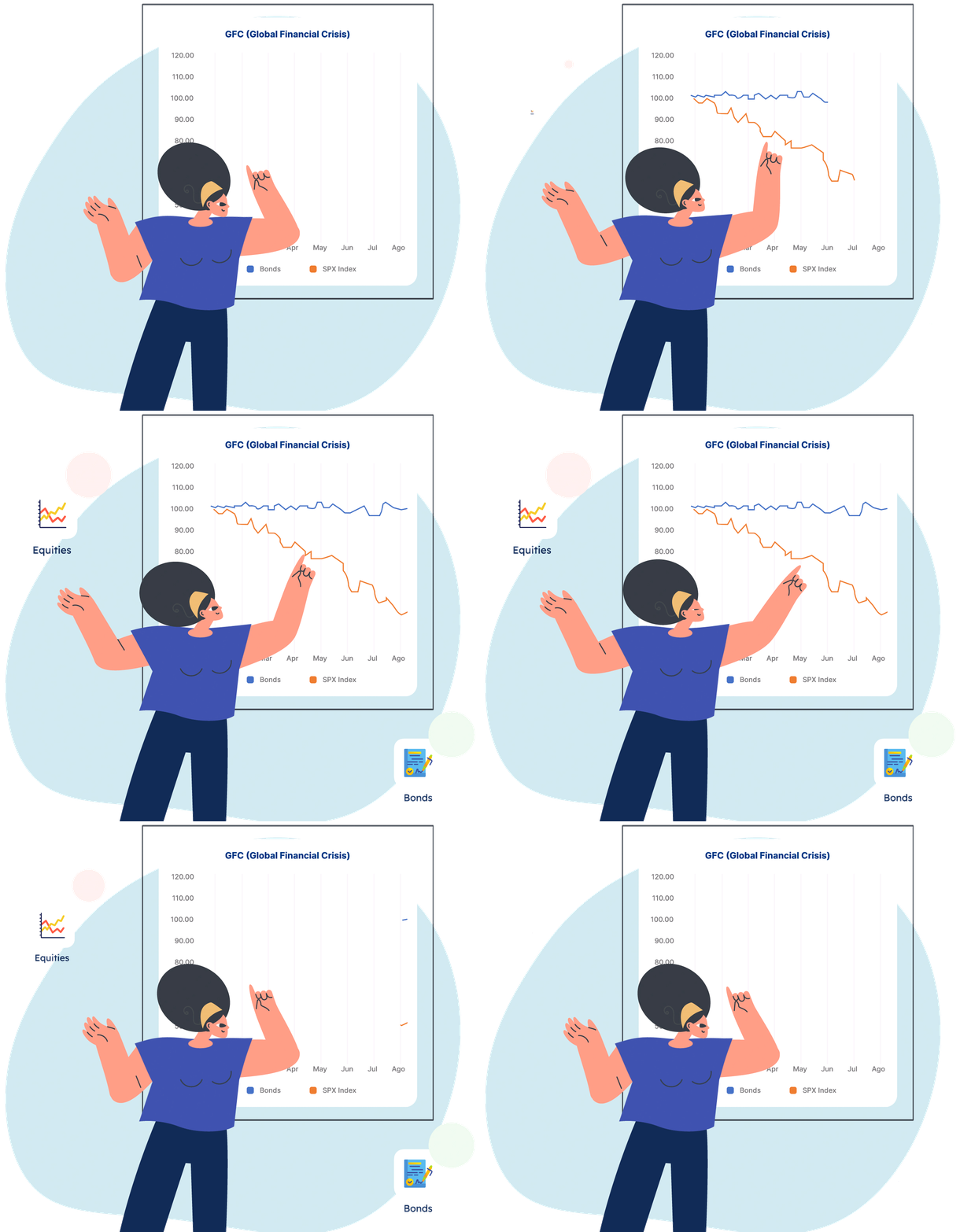
Diversification may also help smoothen the volatility of investment returns over time.

Since different asset classes have different return patterns, combining them in a diversified portfolio can potentially provide more stable returns compared to relying on a single asset class.

With the illustration above, do you think you have a good grasp on the concept of diversification?


Download completed
successfully

Hope you have understood the importance of asset
diversification
from the different scenarios.
If you would like to have a look at different scenarios, click on Yes button to download the
infographic. If not, you can click on No button.

This material has been prepared for information purposes only. No offer to buy or sell or solicitation or
incitement to
offer to buy or sell any securities or advisory or other investment related services is made. This
document is meant to
provide a broad overview for discussion and/or information purposes only. Any Funds managed by AllianzGI
SG or its
ailiates, directly or indirectly referred to are not registered or authorized for public distribution in
Thailand and no offer
of such Funds or solicitation to purchase is made. Neither AllianzGI SG nor any of its ailiates are
licensed to carry out
securities business in the category of investment advisory services or otherwise in Thailand. To the
extent that the
laws of Thailand permit provision of investment advisory services to Thai investors by a foreign
investment advisor
without a licence in Thailand, no such advice or services is offered expressly or impliedly to any person
other than
qualifying institutional investors able to invest in overseas securities under Thai law. The content of
this document and
information provided herein is strictly intended for authorized recipients; eyes only and should not be
extracted or
distributed to any other person without the consent of AllianzGI SG. This material has not been approved
by the
Securities and Exchange Commission of Thailand which takes no responsibility for its contents. No offer to
the public
to purchase the Shares will be made in Thailand and this material is intended to be read by the addressee
only and
must not be passed to, issued to, or shown to the public generally.
This document is meant to provide a broad overview for discussion and/or information purposes only.
NO ACTION HAS BEEN, OR WILL BE, TAKEN TO COMPLY WITH MALAYSIAN LAWS FOR MAKING AVAILABLE,
OFFERING FOR SUBSCRIPTION OR PURCHASE, OR ISSUING ANY INVITATION TO SUBSCRIBE FOR OR
PURCHASE OR SALE OF THE SHARES IN MALAYSIA OR TO PERSONS IN MALAYSIA AS THE SHARES ARE
NOT INTENDED BY THE ISSUER TO BE MADE AVAILABLE, OR MADE THE SUBJECT OF ANY OFFER OR
INVITATION TO SUBSCRIBE OR PURCHASE, IN MALAYSIA. NEITHER THIS DOCUMENT NOR ANY DOCUMENT
OR OTHER MATERIAL IN CONNECTION WITH THE SHARES SHOULD BE DISTRIBUTED, CAUSED TO BE
DISTRIBUTED OR CIRCULATED IN MALAYSIA. NO PERSON SHOULD MAKE AVAILABLE OR MAKE ANY
INVITATION OR OFFER OR INVITATION TO SELL OR PURCHASE THE SHARES IN MALAYSIA UNLESS SUCH
PERSON TAKES THE NECESSARY ACTION TO COMPLY WITH MALAYSIAN LAWS.
This material has been prepared for information purposes only. No offer to buy or sell or solicitation or
incitement to
offer to buy or sell any securities or advisory or other investment related services is made. This
document is meant to provide a broad overview for discussion and/or information purposes only and is not
intended to refer expressly or
impliedly to any funds managed by AllianzGI SG or its ailiates, which funds are not registered or
authorised for
public distribution in Indonesia. Neither AllianzGI SG nor any of its ailiates are licensed to offer or
solicit securities or
investment advice in Indonesia. No such offer is made or intended.
This material has been prepared for information purposes only. No offer to buy or sell or solicitation or
incitement to
offer to buy or sell any securities or advisory or other investment related services is made. AllianzGI SG
is not
licensed in the Philippines to offer or provide fund management or financial advisory services and no such
offer is
made or intended.
THE SECURITIES BEING OFFERED OR SOLD HEREIN HAVE NOT BEEN REGISTERED WITH THE SECURITIES
AND EXCHANGE COMMISSION UNDER THE SECURITIES REGULATION CODE. ANY FUTURE OFFER OR SALE
THEREOF IS SUBJECT TO REGISTRATION REQUIREMENTS UNDER THE CODE UNLESS SUCH OFFER OR
SALE QUALIFIES AS AN EXEMPT TRANSACTION.
Information herein is based on sources we believe to be accurate and reliable as at the date it was made.
The
information provided in this material is for informational purposes only and is intended solely for use by
the intended
recipients and is not intended for distribution to, or use by, any person or entity in any jurisdiction or
country where
such distribution or use would be contrary to law or regulation, or any of Allianz Global Investors;
products or services
where registration requirement within such jurisdiction or country is required. We reserve the right to
revise any
information herein at any time without notice. No offer or solicitation to buy or sell securities and no
investment advice
or recommendation is made herein. In making investment decisions, investors should not rely solely on this
publication
but should seek independent professional advice. Investment involves risks including the possible loss of
principal
amount invested and risks associated with investment in emerging and less developed markets. There is no
guarantee
that these investment strategies and processes will be effective under all market conditions and investors
should
evaluate their ability to invest for a long-term based on their individual risk profile especially during
periods of downturn
in the market. Past performance, or any prediction, projection or forecast, is not indicative of future
performance. The
duplication, publication, extraction, or transmission of the contents, irrespective of the form is not
permitted, except for
the case of explicit permission by Allianz Global Investors. This publication has not been reviewed by the
Monetary
Authority of Singapore (MAS) and is published for information only. The issuer of this publication is
Allianz Global
Investors Singapore Limited (79 Robinson Road, #09-03, Singapore 068897, Company Registration No.
199907169Z).
Disclaimer
This material is for your reference only and is not intended as a substitute for any
professional
investment advice.
Where applicable, the data input and the results calculated will not be stored. Allianz Global
Investors shall not
accept any responsibility for any inaccuracies, errors or omissions from this material. This
material
has not taken into
account your risk profile and financial needs
Investing involves risk. The value of an investment and the income from it will fluctuate and
investors may not get
back the principal invested. Past performance is not indicative of future performance. This is a
marketing
communication. It is for informational purposes only. This document does not constitute
investment
advice or a
recommendation to buy, sell or hold any security and shall not be deemed an offer to sell or a
solicitation of an offer to
buy any security.

